
Activating the Ecosystem Alliance: a research week in situated practice
Marine Science student with a strong interest in conservation and restoration
In September 2025, a group of students and graduates from MA Regenerative Design from Central Saint Martins came together for a research week dedicated to biodiversity restoration. Hosted by Barbara Smith and Judith van den Boom, this research week marked an important step toward launching the Ecosystem Alliance, a platform and initiative designed to bring ecologists and designers into closer collaboration. Our shared aim: to activate place-based biodiversity restoration while building new forms of collective inquiry and practice.
The Ecosystem Alliance emerges from a need we increasingly feel across regenerative fields, an urgency to bridge disciplinary practices and boundaries and develop new methods that transcend traditional silos but can collectively create impact that we would not be able to do alone. Biodiversity restoration is not just a scientific challenge; it is a social, cultural, and material challenge as well that requires creative approaches, community action, and long-term collaboration. As a group we were very happy to find that alignment with the Kilchoan Melfort Trust and work on site, connected with their team and expertise.
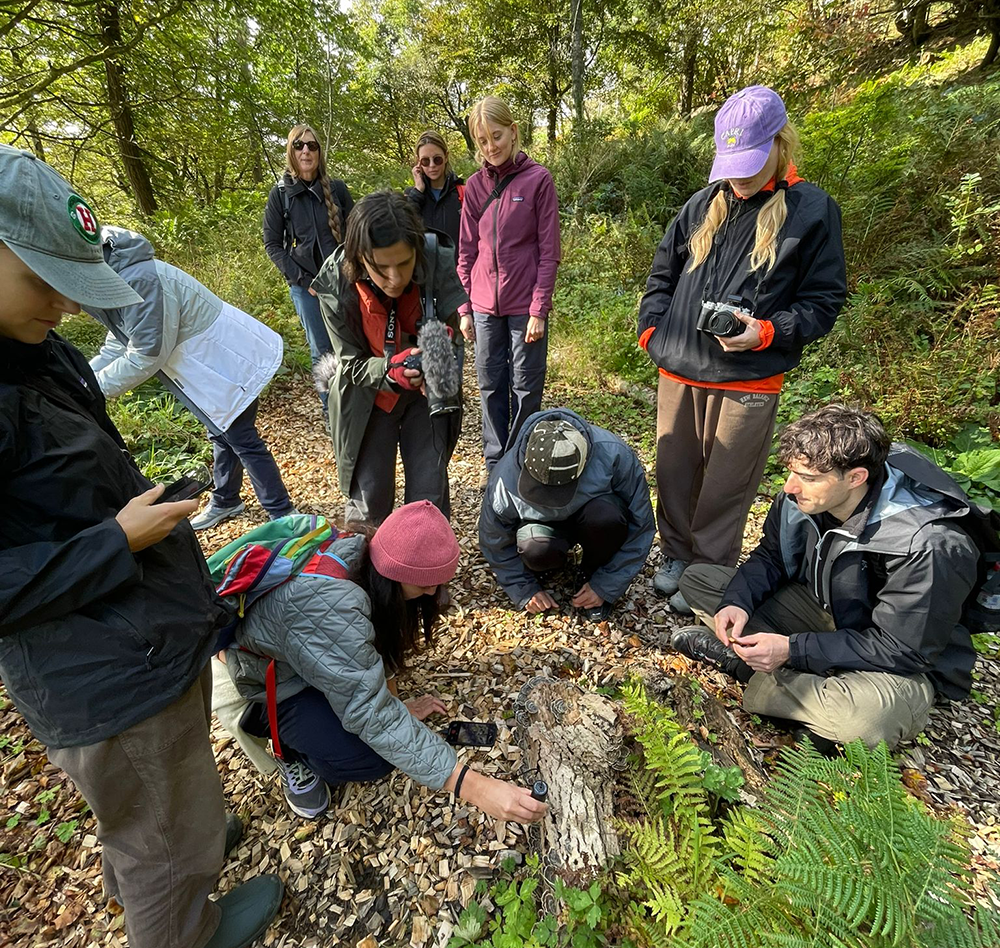
This research week was set up to take the research group through experience, learning, case-studies and hands-on support on the estate of Kilchoan Melfort Trust. Learning that biodiversity restoration is not a romantic action but a complex layered reality.
Situated Activation
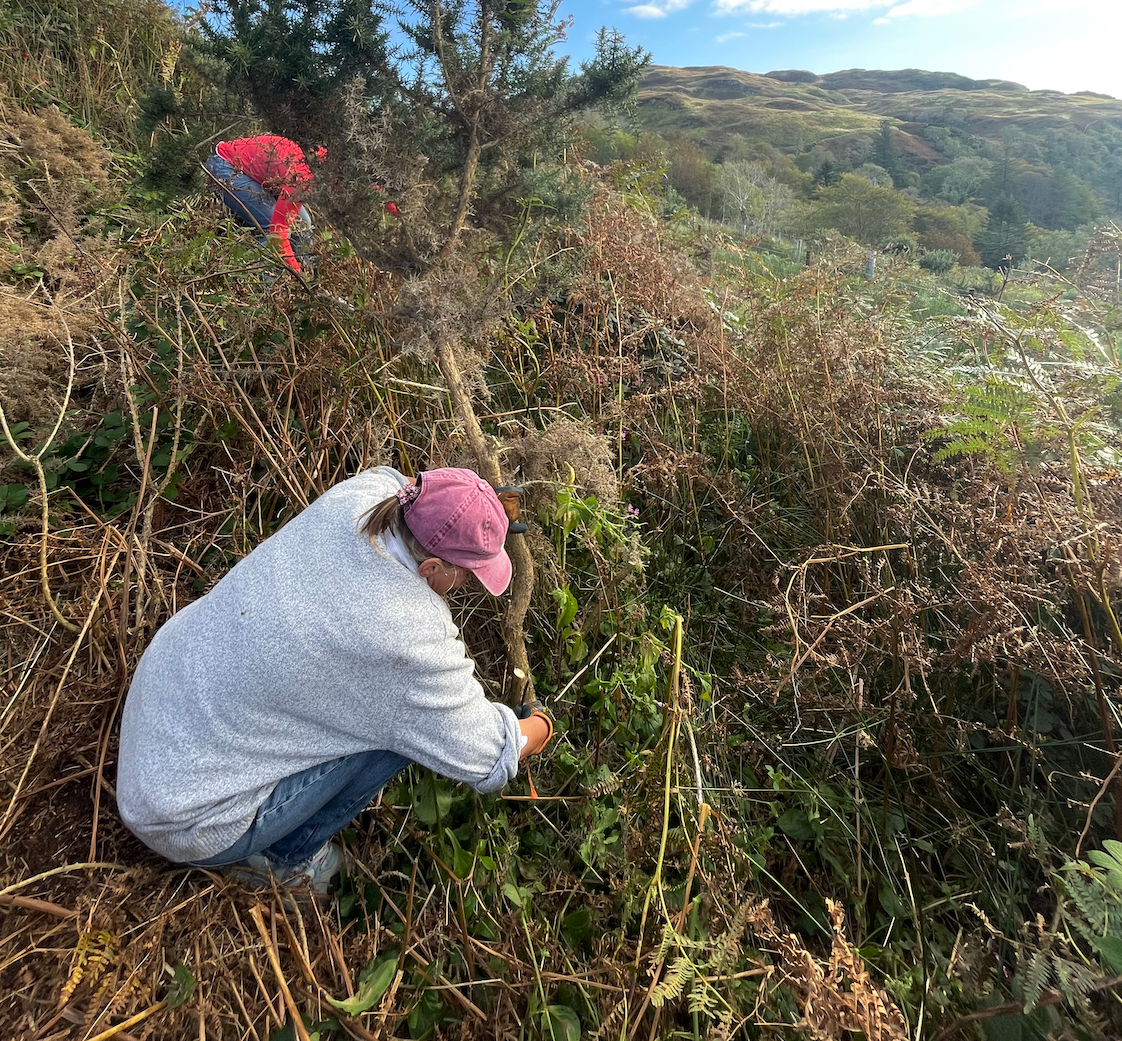
Our field activation at Kilchoan Melfort Trust informed our thinking, practice and research. The landscape became both our teacher and collaborator. By working and learning from the team and working side by side removing gorse and vole guards on the hills we had a chance to learn how everything is related. The activation and constant conversation and action helped to challenge assumptions, exchange and explore ideas in place.
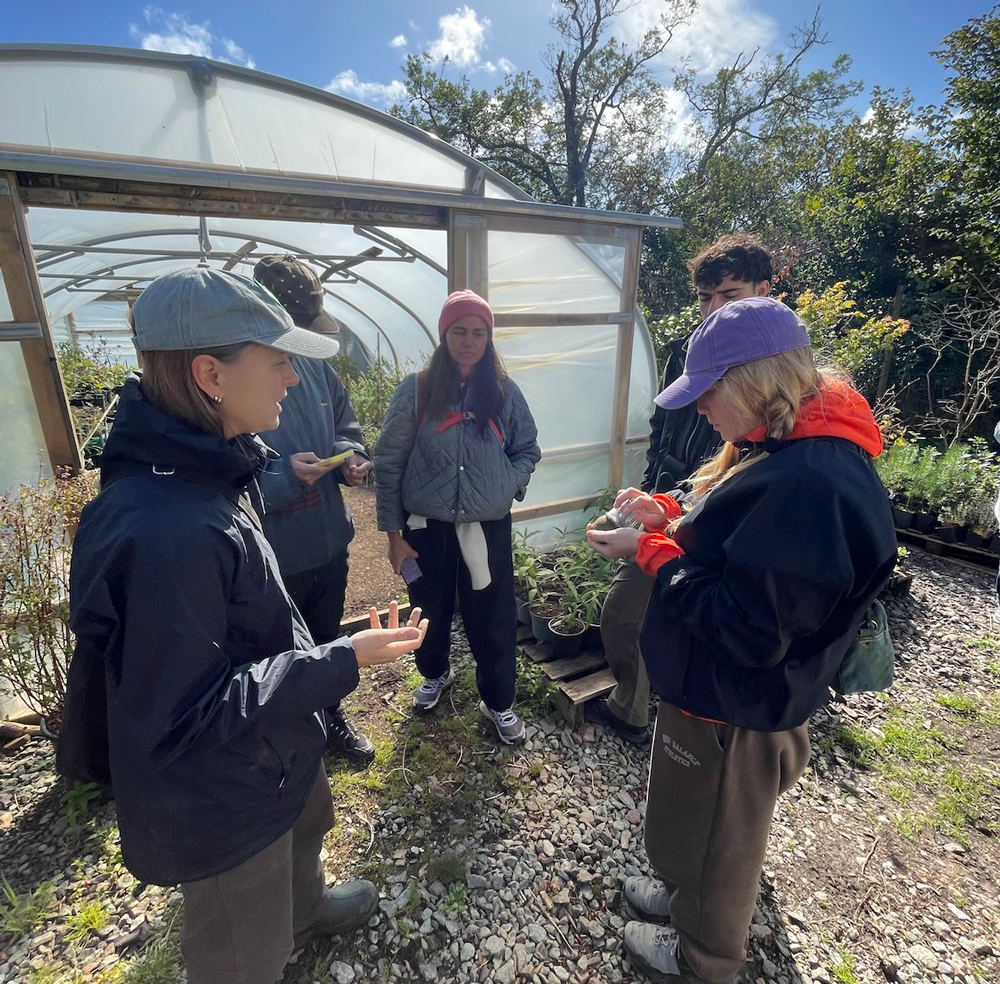
Beside being in place and working closely with the Kilchoan Melfort Trust team we also made two site visits to Dr. Alasdair O’Dell at SAMS (Scottish Association for Marine Science) and Dr. Alex Thompson at Seawilding to learn about various practices of how research is developed. Through this we explored biodiversity restoration across scales, from academic research to applied fieldwork and community-led initiatives.
Fieldwork as Method
A central part of the week was hands-on fieldwork. We removed gorse to revive meadows and collected plastic tree guards across the hills. These are small but significant interventions in a dynamics of landscape that helps us stop projecting and designing but rather start with first learning and understanding the dynamics of place, time and species.
These embodied practices help us shift our understanding of regenerative design. Away from the studio and into the field, we learn to listen to place, to species, and to the histories embedded in land use. In order to think about the future we need to learn from how we are situated. Restoration work requires attention to ecological context, local and the cultural relationships communities in the landscapes. The manual labour became a form of inquiry, it is body intensive, slow, relational, and deeply instructive. By working with land we began to understand that biodiversity restoration is not a technical fix but a longterm, collaborative process that teaches about scale, time and where we enter and contribute in the process of restoration.
Interdisciplinary Practice
If we are to design with ecosystems, and not just for, we need to develop and adopt modes of working that mirror the ecological relationships: interconnected, adaptive, and collaborative. Designers bring methods of imagination, communication, and exploration and ecologists bring empirical grounding, ecosystems knowledge and systemic insight. Together, these can form new languages and practices for regenerative work. We hope that with the Ecosystem Alliance we can build this test-space and activated learning network to connect our disciplines, learners, activators, and local experts. Scotland became our first meeting ground and we hope to build a more long-term relationship to keep evolving.
Emerging Methods
The long-term aim of the Ecosystem Alliance is to develop new empirical biodiversity methods that support collaboration between ecologists, designers, and local communities. Working in the ecotones, where marine, terrestrial and people meet, we hope to cultivate practices that thrive from complexity.
This first project focused on constructing new methodologies through direct engagement and the research group developed proposals on different scales. From thinking through material, local contexts, relations, community, collaboration and paradigm shifts. Recognising that biodiversity restoration does not sit on one level but needs to be distributed and activated across the systems we are part of. As a group we experimented, asked questions, observed, and tested.
The work proposed and in development ranges from: frameworks for designers and ecologists to work together using ecological data, inspired by Life Cycle Assessment (LCA) processes, reframing data-collection and design interventions, rethinking citizen-science initiatives and local geographical understanding and assessments to rethinking how regenerative design practices can operate as part of ecosystem and support new functions and ways of seeing the world
All the work of our research group and three short films can be viewed on www.ecosystemsalliance.earth
Key insights from our week
- Restoration requires long horizons, ecological change unfolds over decades, not months, demanding humility, knowledge and patience.
- Design must slow down and attune, regenerative design becomes most effective when it listens before it intervenes and builds place-based partnerships
- Data and stories need to meet, ecological data becomes more powerful when coupled with local knowledge and lived experience.
- Interdisciplinarity is essential, no single discipline can handle the complexity of ecosystems; collaboration is not optional but foundational.
- Situated practice is our methodology, from removing gorse to documenting our weeks findings, the week highlighted that being situated is both a mindset and a method.
On 19 November, we hosted an online biodiversity symposium where a wide range of practices, disciplines, and partners came together.
The team from the Kilchoan Melfort Trust joined the digital table to share their perspectives on biodiversity restoration, its challenges, effective practices, and opportunities for collaboration. We are deeply grateful for this partnership and look forward to developing it further in the future, so that together we can build stronger spaces for advancing biodiversity knowledge and practice.
Selection of responses from our EA research group
Lesley Roberts (USA)
My research extends craft and regenerative practice beyond fibres and materials into questions of agency, meaning, and enchantment. I’m interested in how we move from awareness into applied practice, how we step behind the naming and the mapping to explore what remains hidden or not yet articulated. The trip allowed me to sit with these “before” spaces, the corners we often overlook, and ask how else we might engage with more-than-human worlds.
Inés Quiñones Fábregas (Spain)
This experience deepened my understanding of the complexities of biodiversity restoration. My work in biocultural regeneration now feels newly grounded. I’ve realised how often biodiversity is overlooked in sustainable design conversations and how essential it is that designers learn to engage with it thoughtfully and explicitly.
Lucy Michell (UK)
Being in Scotland allowed me to learn directly from ecologists and compare upland blanket bog systems with the lowland peatlands of the East Anglian Fens. These comparisons helped me think about shared dynamics across habitats and across disciplines. Design, despite its breadth, can be difficult for others to navigate. By aligning more closely with ecological methods and timescales, designers can develop more grounded, impactful, and pragmatic contributions to biodiversity restoration.
Charline Lalanne (France)
Our Scotland experience was of deep observation. Not looking, but searching for the invisible relationality of a place with the living systems. It opened up awareness on the ground work of biodiversity restoration: one of understanding, care and continuity. The mens and womens on site shared their passion for all living entities in and beyond the estate. That was the starting point of my project and one that I hope to carry into my practice.
Gabriella Rhodes ( UK)
The fieldwork and site visits at Kilchoan Melfort Trust, SAMS, and Seawilding, providing insight into how biodiversity restoration operates in real-world contexts. I saw the entanglement of geology and ecology at Kilchoan Melfort Trust through unearthed mud from estate vehicle tracks (which I formed into a clay sphere), a Song Thrush nest lined with mud in the Interpretation Hub, and a visitor book map of local geology. but noted how these relational systems are not presented together in one accessible place. Using the iNaturalist app highlighted how publicised biological recording is useful for tracking biodiversity and fostering public awareness and connection to nature, yet there was no way to see how biotic and abiotic systems interact. Witnessing the estate’s, SAMS’s, and Seawilding’s work emphasised the importance of collaborations and co-stewarding between science and communities. The experience reinforced that biodiversity restoration needs to be place-based, relational, responsive, and attentive to multiple ways of knowing, strengthening my commitment to developing methodologies that bridge ecological, artistic, and material practices.
This research expedition was supported by the LVMH Maison/0 Challenge Fund at Central Saint Martins, which aims to develop creative collaborations through student and graduate-led engagement. These collaborations are designed around a specific brief or challenge, this year related to ‘Biodiversity’.
We want to acknowledge our partnership with the Kilchoan Melfort Trust.
With special thanks to:
Marnik van Cauter, Laura Dawson, and Louisa Habermann at Kilchoan Melfort Trust
Dr. Alasdair O’Dell (Scottish Association for Marine Science)
Dr. Alex Thomson (Seawilding)
Mátyás Csiky (Open Climate Solutions)
Our research group MA Regenerative Design, CSM
Quoi Alexander
Inés Quiñones Fábregas
James Harlow
Sami Kimberley
Charline Lalanne
Tom Longmate
Lucy Mitchell
Gabriella Rhodes
Lesley Roberts
Nana Maiolini, for creating three beautiful films and joining us on-site.
Judith van den Boom and Barbara Smith, founders of the Ecosystem Alliance